
This post marks my third blog of many. That means time to get down to what I did in my spare time for the first sports season. Why are you blogging about sports if everyone else is doing the same thing? Simple, to teach you all a lesson. Starting the week before school had Cross Country. The sport that if I'm correct, gets the least amount of the school's money. Football, Soccer, Basketball, Cheerleading, and Field Hockey go ahead and complain that you have the worst and hardest sport. You all get water, right? You get to sit on the bench while your teammates are doing all the work for you? Well, that's not what it's like in cross country. Try no breaks, running for two hours straight during practice, aching muscles and bones, cramps, having to drink so much water that you constantly have to go to the bathroom. Well, that's just a fraction of the aches and pains we have. Our very own high school team made up a saying that will follow us all the way through high and possibly collage, "even though the aches and pains I'll run three miles anyway". That means it could be that week of the month (hinting to girls) or you could have a severely sprained ankle but you still do the race improving each time. If you have a running religious friend then here are some things that he/she might say. You might have trouble understanding what they mean if you are not a runner but that link might help a bit. Us runners think that the world is practically out to kill us. To add to that only like two of your teammates might actually like to run. We don't even know why we do the sport.
Some things about the sport are the following, Cross Country Running is a sport in which teams and individuals run a race on open-air courses over natural terrains such as dirt or grass. The course may include surfaces of grass, and earth, pass through woodlands and open country and include hills, flat ground and sometimes gravel road. It is both an individual and a team sport; runners are judged on individual times and teams by a points-scoring method. Both men and women of all ages compete in cross country, which usually takes place during autumn and winter, and can include weather conditions of rain, sleet, snow or hail, and a wide range of temperatures.
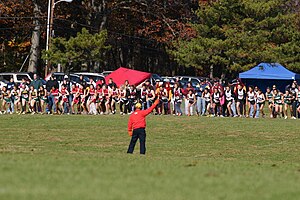 All runners start at the same time, from a starting arc (or line) marked with lines or boxes for each team or individual. An official, 50 meters or more in front of the starting line, fires a pistol to indicate the start. If runners collide and fall within the first 100 meters, officials can call the runners back and restart the race, however, this is done only once. Crossing the line or starting before the starting pistol is fired is considered a false start and most often results in disqualification of the runner.
Some things about the sport are the following, Cross Country Running is a sport in which teams and individuals run a race on open-air courses over natural terrains such as dirt or grass. The course may include surfaces of grass, and earth, pass through woodlands and open country and include hills, flat ground and sometimes gravel road. It is both an individual and a team sport; runners are judged on individual times and teams by a points-scoring method. Both men and women of all ages compete in cross country, which usually takes place during autumn and winter, and can include weather conditions of rain, sleet, snow or hail, and a wide range of temperatures.
Start
All runners start at the same time, from a starting arc (or line) marked with lines or boxes for each team or individual. An official, 50 meters or more in front of the starting line, fires a pistol to indicate the start. If runners collide and fall within the first 100 meters, officials can call the runners back and restart the race, however, this is done only once. Crossing the line or starting before the starting pistol is fired is considered a false start and most often results in disqualification of the runner.Finish
The course ends at a finish line located at the beginning of a funnel or chute (a long walkway marked with flags) that keeps athletes single-file in order of finish and facilitates accurate scoring.
Depending on the timing and scoring system, finish officials may collect a small slip from each runner's bib, to keep track of finishing positions. An alternative method (standard in the UK) is to have four officials in two pairs. In the first pair, one official reads out numbers of finishers and the other records them. In the second pair, one official reads out times for the other to record. At the end of the race, the two lists are joined along with information from the entry information. The primary disadvantage of this system is that distractions can easily upset the results, particularly when scores of runners finish close together.
Chip timing has grown in popularity to increase accuracy and decrease the number of officials required at the finish line. Each runner attaches a transponder with RFID to his or her shoe. When the runner crosses the finish line, an electronic pad records the chip number and matches the runner to a database. Chip timing allows officials to use checkpoint mats throughout the race to calculate split times, and to ensure runners cover the entire course. This is by far the most efficient method, although it is also the most expensive. The drawback to chip timing is its inability to separate a close finish properly. Chips times the feet, when the rule books say it is the torso that counts. It is technically possible for an athlete to fall across the finish line, legally crossing the finish line, but with their feet too far away from the sensor to have their finish recorded.
Contemporary races have now started to use fully automatic timing systems for photo finish accuracy to their results. This has dramatically improved the timing mechanisms of Cross Country over the last few years.

Nice job! I enjoyed reading this very much! <3
ReplyDeleteLove it… the world needed this. Yes, this is actually what it is like! Despite this, I would not trade this sport for anything. Right Riley?
ReplyDeleteP.S. Just some feedback, maybe talk about the actual running process next time. On a totally unrelated note, does anyone do a fall sport?
DeleteThis comment has been removed by the author.
DeleteThanks Izzy! I'll make sure to do that next time.
ReplyDeleteThat was fantastic, Rylee! Thank you for putting that out there. Us runners really needed that.
ReplyDelete