
My name is Rylee Dennis and this week my blog will be about dragons. Today we will be talking about all the tribes in the Wings of Fire book series. Everything in this is based on my knowledge of the Wings of Fire Dragons according to the books.
Dragons are the current dominant species of Pyrriah and Pantala. Scavengers once ruled Pyrrhia (their history in Pantala is currently unknown - except for Blue and Cricket referring to them as "reading monkeys"), but dragons overthrew them in an event known as The Scorching. Dragons are fairly intelligent, as they are capable of speech (particularly Dragon), tool-making, and many other abilities that are common in advanced societies. Very few members of the dragon population are known as animus dragons, who possess powerful magic that is capable of causing practically anything - with the exception of raising the dead back to life - to happen. These powers can be performed by speech or thought, and it has been confirmed that animus magic is not specific to any one tribe; additionally, animus dragons can be artificially created (see: Talons of Power), but animus power is naturally genetic. Also, if the animus dragons use their magic to much the magic can eat away at the dragons soul. Although some dragons have died of old age, sickness, and/or injury throughout the series, dragons can live for more than one hundred years before they die peacefully in their sleep, according to Starflight. In addition to Tui Y. Sutherland stating that the average dragon lifespan is roughly 150 years, Tapir, a RainWing, managed to live for 110 years before his death. Dragon to scavenger age conversions: four to seven-year-olds are teenagers, seven to eight-year-olds are young adults, and anyone above nine years of age is considered an adult. Pyrrhiah dragons fall into one of seven known tribes: Rainwings, Seawings, Skywings, Sandwings, Mudwings, Nightwings, and Icewings. Hybrids between tribes are possible, but hybrid dragons are uncommon due to tribe rivalry. Pantala currently supports three known species: Silkwings,Leafwings, and Hivewings along with Beetlewings, which are now extinct. All tribe members are roughly the same size with the exception of MudWings, who are generally larger (and typically stronger) than dragons from the other tribes. Dragons have been confirmed to grow as they age, with the oldest dragons typically being the largest in size. Dragons grow rapidly for the first eight to ten years of their life, then grow at a much slower rate for the rest of their lives. All dragons are primarily quadrupedal. Pyrrhian and some Pantalan dragon bodies possess six limbs, two wings, and four arms/legs. Wings are attached to a dragon's shoulders and have a slightly transparent wing membrane stretched between five small bone digits, each of which have one small claw on the tip. A larger claw is attached to the front of the third digit. HiveWings and SilkWings, however, have eight limbs, four of which are wings and four of which are arms and legs. SilkWing wings are softly curved and resemble that of a butterfly, while HiveWing wings are thinner and resemble those of a dragonfly. According to Tsunami, dragon bones are nearly as hard as diamonds and quite difficult to break, however, Tsunami's ribs do break in The Lost Heir. The average dragon height is around 18 ft. All dragons have large claws at the base of each foot (five on the forelegs and four on the hindlegs) and all can fly, regardless of tribe. Each tribe has different abilities according to their environment, so although not all tribes can breathe fire, each has at least one ability. IceWings have deadly frost breath, serrated claws, whip-thin tails, and a resistance to cold temperatures and bright light; SeaWings have gills, powerful tails, are strong swimmers, and are capable of bioluminescence; RainWings have color-changing scales and deadly venom; SilkWings can shoot silk from wrist glands; HiveWings have abilities that differ from dragon to dragon; LeafWings are sometimes able to have control over plants and can absorb sunlight for nutritional purposes. Most species seem to be omnivorous, although the majority of their diet consists of meat. SkyWings are carnivorous, however. Most dragons have large, sharp teeth suited to their diet. RainWings and SilkWings, however, are prominently herbivores, subsisting mainly on fruit. Most dragons can survive for up to a month without food. Dragons reproduce by making eggs, which usually hatch into young dragons called dragonets after a year of carrying and a year of incubation. It is mentioned on several occasions that dragons have a hoarding instinct similar to crows, preferring shiny or brightly colored objects. Instead of a currency system, dragons on Pyrrhia typically barter these items or other valuables. Each tribe has specialized structures and abilities that differentiate them from the other tribes. Most typical is some sort of exhalation, most commonly fire. SkyWings, NightWings, and SandWings can breathe fire at any given time, whereas MudWings can only breathe fire when they are warm enough. IceWings exhale a freezing breath, while RainWings can spit corrosive acid that only affects biological matter. SeaWings are the only tribe on Pyrrhia that cannot exhale anything that may be used as a weapon, and none of the tribes on Pantala can, aside from the occasional acid- or poison-spitting HiveWing. The most commonly modified structures in dragons are either the wings, the claws, or the tail.
Dragons of Pyrriah
 IceWings have modified claws to grip the ice, powerful frostbreath that has the ability to snap off limbs after contact, resistance to below-freezing temperatures so they can stay alive and comfortable in their habitat, and before Prince Artic ran away with Foeslayer, IceWings used to have animus magic running through the royal family. They are also highly resistant to being blinded by bright light. IceWings have also been shown to be able to camouflage in the snow in their natural habitat. IceWings are shown to be able to swim, according to Darkstalker (ledgends) and Winter Turning.
 MudWings have nostrils located on the top of the snout to allow them to breathe while submerged in mud and water. In addition, they can hold their breath for up to an hour and have tough and armored scales for extra protection. However, occasionally, a blood-red MudWing egg will hatch, giving the dragonet inside the ability to resist fire. This power is strengthened or activated by being in the mud, which also strengthens MudWings in general. An example of a fireproof MudWing would be Clay.
 NightWings were thought to have telepathy, as well as precognition, or the ability to predict future events. However, no NightWing has had these abilities in over a century (other than Moonwatcher), explaining why Starflight has no powers in the original series. It is later revealed by Darkstalker that these NightWing powers are gotten by at least one of the three moons being full and able to shine on an egg. One full moon gives the powers of either precognition or telepathy. Two full moons give both. Three full moons had once been thought to give animus magic, Darkstalker claims, but this theory was proved wrong. Now they are thought to give powerful telepathy and precognition, but this has not been proven. The NightWings have not hatched their eggs under the moonlight (besides Moonwatcher's and possibly Fatespeaker's) for around 2000 years, which may be because of the fact that they never wanted to have another Darkstalker. NightWings may also have bacteria in their saliva to help kill prey, similar to a Komodo dragon. They have created a veil of mystery around themselves, and not much else is known about their abilities, but it is thought they are slightly resistant to lava and fire, as shown when Vengance didn't die immediately from the lava he was submerged in. Like the SeaWings and ancient IceWings, some NightWings have animus powers, passed down from Whiteout.
 RainWings possess prehensile tails, similar to a chameleon's, used for navigating the forest. It was fairly recently discovered that they can also spit a deadly venom from their fangs which they rarely use. Most noticeably, they have the ability to change the color of their scales to help them camouflage, however, it can also express their mood.
 SandWings possess a venomous barb on their tail that is lethal to other life forms, as well as also having the ability to exhale fire. SandWings are able to go for a long time without water, which helps them survive in the desert. Also, back in the time period of Darkstalker (Legends), there was one animus SandWing named Jerboa which proves that the SandWings may have previously had animus blood. It is revealed that Jerboa has one daughter.
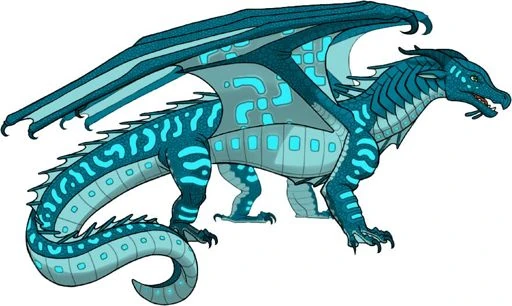 SeaWings are the most well equipped underwater, having gills, along with the ability to see in the dark to help them navigate their watery home. They have powerful webbed claws and tails that help them swim noticeably better than the other tribes, they also use bioluminescence to communicate while underwater by using a language called Aquatic. SeaWings also have animus blood running through the royal family. Some animus dragons include Prince Fathom, Princess Orca, Princess Anename, and Prince Turtle.
 SkyWings have large, almost overdeveloped wings with an extra digit on each wing, making them the best fliers among the dragons and having the ability to fly at a younger age than other tribes. They also have the ability to exhale fire. Sometimes, when SkyWings hatch in twin eggs, one of the twin dragonets absorbs all of their other twin's fire so that they have abnormally hot fire and can burn anything on touch, called firescales; their other twin becomes weak and loses all or most of their fire ability. An example of dragons with these abilities would be Pearl and her brother. SkyWings stated to typically kill off any firescale or animus dragons that are born as soon as they are discovered. SkyWings are also said to have animus dragons in Escaping Peril, although most of these special dragons don't survive since the popular tradition of the SkyWings is to drop them off a cliff before they can fly.
Dragons of Pantala
 HiveWings have four wasp or dragonfly-like wings. Their abilities differ from dragon to dragon, usually involving poison or acid of some sort. Some have stingers on their tails, used to inject nerve poison or spray a deadly acid (Similar to RainWing venom)Some HiveWings have stingers that spring from their claws or teeth, and some even have them on their wingtips. There are many other abilities, and the majority of HiveWings do not have any abilities.HiveWing scales can range from yellow to red to orange, but always with a few black
 SilkWings are born without wings, and they go through a Metamorphosis when they are six, getting their wings. Their scales can be absolutely any color under the sun except black. They can also spin/shoot silk from a set of spinnerets on their wrists. Very rarely they have an ability called flamesilk, where they shoot solid fire (this is genetic). An example of dragons with this ability would be Luna and Blue. SilkWings can spin different types of silk, sometimes like thread, sometimes sticky to be used as construction. Flamesilks can still make silk that won't burn things. All SilkWings can choose which kind of silk they want to spin. HiveWings use flamesilk to create lights and normal silk as an ingredient in treestuff, to create most buildings and Hives. Some SilkWings, like Tau, have wing deformities that hinder them from flying, which may have happened as a result of metamorphosis
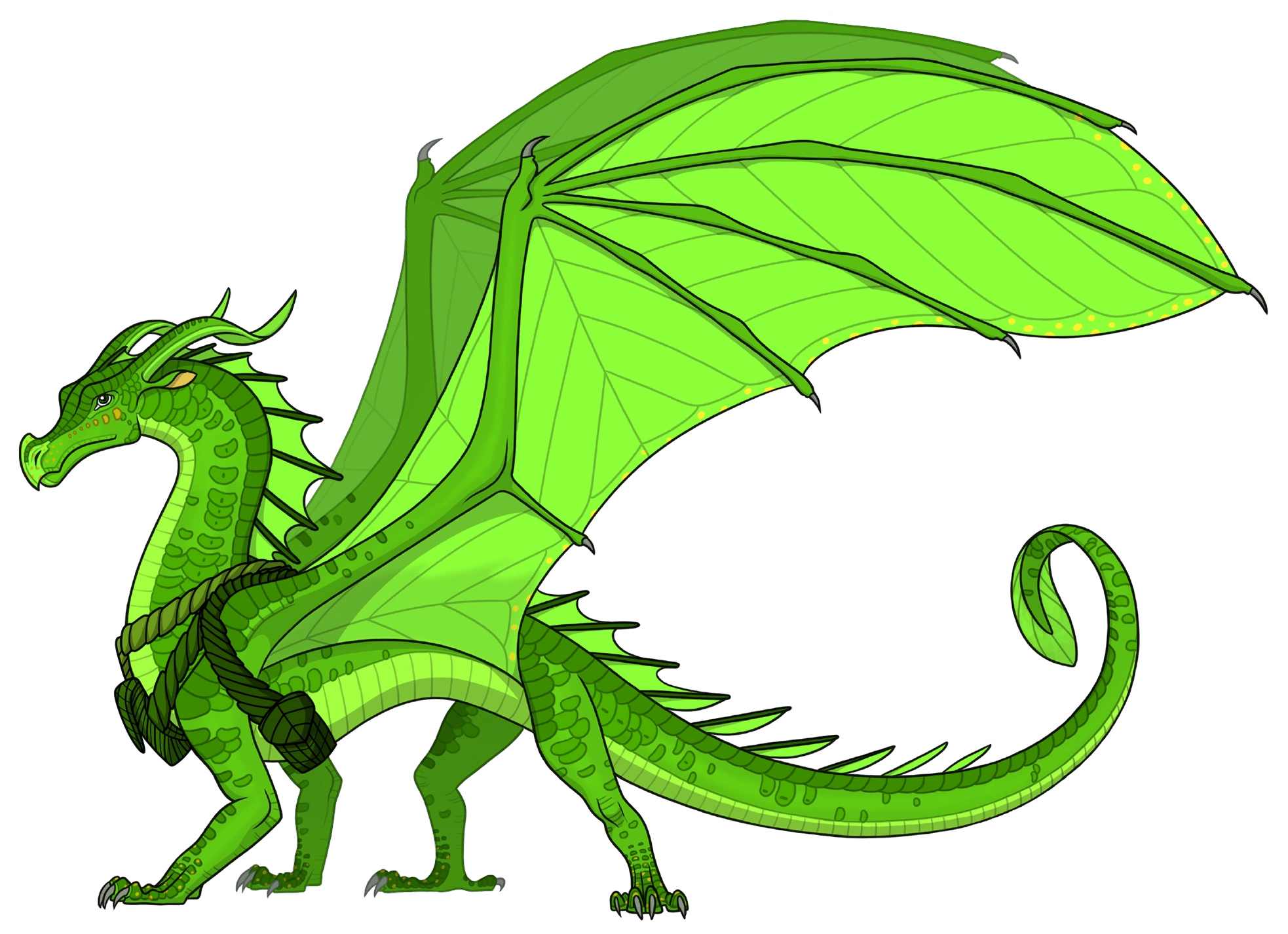 Leafwings can absorb sunlight and use it for energy, were accomplished gardeners, and some were rumored to have unusual control over plants (Sundew has these abilities, as she is shown controlling plant roots into pushing stones in The Lost Continent.. The LeafWings call it Leafspeak). Their wings are shaped like leaves. They usually have a coloring of brown, green, or gold-flecked scales.
Dragons are the current dominant species of Pyrriah and Pantala. Scavengers once ruled Pyrrhia (their history in Pantala is currently unknown - except for Blue and Cricket referring to them as "reading monkeys"), but dragons overthrew them in an event known as The Scorching. Dragons are fairly intelligent, as they are capable of speech (particularly Dragon), tool-making, and many other abilities that are common in advanced societies. Very few members of the dragon population are known as animus dragons, who possess powerful magic that is capable of causing practically anything - with the exception of raising the dead back to life - to happen. These powers can be performed by speech or thought, and it has been confirmed that animus magic is not specific to any one tribe; additionally, animus dragons can be artificially created (see: Talons of Power), but animus power is naturally genetic. Also, if the animus dragons use their magic to much the magic can eat away at the dragons soul. Although some dragons have died of old age, sickness, and/or injury throughout the series, dragons can live for more than one hundred years before they die peacefully in their sleep, according to Starflight. In addition to Tui Y. Sutherland stating that the average dragon lifespan is roughly 150 years, Tapir, a RainWing, managed to live for 110 years before his death. Dragon to scavenger age conversions: four to seven-year-olds are teenagers, seven to eight-year-olds are young adults, and anyone above nine years of age is considered an adult. Pyrrhiah dragons fall into one of seven known tribes: Rainwings, Seawings, Skywings, Sandwings, Mudwings, Nightwings, and Icewings. Hybrids between tribes are possible, but hybrid dragons are uncommon due to tribe rivalry. Pantala currently supports three known species: Silkwings,Leafwings, and Hivewings along with Beetlewings, which are now extinct. All tribe members are roughly the same size with the exception of MudWings, who are generally larger (and typically stronger) than dragons from the other tribes. Dragons have been confirmed to grow as they age, with the oldest dragons typically being the largest in size. Dragons grow rapidly for the first eight to ten years of their life, then grow at a much slower rate for the rest of their lives. All dragons are primarily quadrupedal. Pyrrhian and some Pantalan dragon bodies possess six limbs, two wings, and four arms/legs. Wings are attached to a dragon's shoulders and have a slightly transparent wing membrane stretched between five small bone digits, each of which have one small claw on the tip. A larger claw is attached to the front of the third digit. HiveWings and SilkWings, however, have eight limbs, four of which are wings and four of which are arms and legs. SilkWing wings are softly curved and resemble that of a butterfly, while HiveWing wings are thinner and resemble those of a dragonfly. According to Tsunami, dragon bones are nearly as hard as diamonds and quite difficult to break, however, Tsunami's ribs do break in The Lost Heir. The average dragon height is around 18 ft. All dragons have large claws at the base of each foot (five on the forelegs and four on the hindlegs) and all can fly, regardless of tribe. Each tribe has different abilities according to their environment, so although not all tribes can breathe fire, each has at least one ability. IceWings have deadly frost breath, serrated claws, whip-thin tails, and a resistance to cold temperatures and bright light; SeaWings have gills, powerful tails, are strong swimmers, and are capable of bioluminescence; RainWings have color-changing scales and deadly venom; SilkWings can shoot silk from wrist glands; HiveWings have abilities that differ from dragon to dragon; LeafWings are sometimes able to have control over plants and can absorb sunlight for nutritional purposes. Most species seem to be omnivorous, although the majority of their diet consists of meat. SkyWings are carnivorous, however. Most dragons have large, sharp teeth suited to their diet. RainWings and SilkWings, however, are prominently herbivores, subsisting mainly on fruit. Most dragons can survive for up to a month without food. Dragons reproduce by making eggs, which usually hatch into young dragons called dragonets after a year of carrying and a year of incubation. It is mentioned on several occasions that dragons have a hoarding instinct similar to crows, preferring shiny or brightly colored objects. Instead of a currency system, dragons on Pyrrhia typically barter these items or other valuables. Each tribe has specialized structures and abilities that differentiate them from the other tribes. Most typical is some sort of exhalation, most commonly fire. SkyWings, NightWings, and SandWings can breathe fire at any given time, whereas MudWings can only breathe fire when they are warm enough. IceWings exhale a freezing breath, while RainWings can spit corrosive acid that only affects biological matter. SeaWings are the only tribe on Pyrrhia that cannot exhale anything that may be used as a weapon, and none of the tribes on Pantala can, aside from the occasional acid- or poison-spitting HiveWing. The most commonly modified structures in dragons are either the wings, the claws, or the tail.
Dragons of Pyrriah
Dragons of Pantala
There are no current images of BeetleWings.
BeetleWings are a species of dragon that went extinct over 5,000 years ago. The book of Clearsight claimes that they were a crossbreed. Long before the Tree Wars, there were only two species of dragons, the BeetleWings, and LeafWings. Clearsight used magic to create SilkWings and HiveWings, they came from the BeetleWings. The BeetleWings we're somewhat a cross of the two tribes. They had the usual four wings, one set more butterfly, the other more bee. They had stingers in their tails, flamesilk of daggers in their wrists, venomous teeth and any other features that a typical SilkWing or HiveWing would. The book of Clearsight does not clearly state why Clearsight split the breed, therefore, making anything else about the tribe unknown.
No comments:
Post a Comment
Please remember the school's code of cyber conduct. All comments will be treated the same as if they were said aloud in the classroom. Please use complete sentences, proper punctuation, and capitalization in your comments.
Mr. Bender